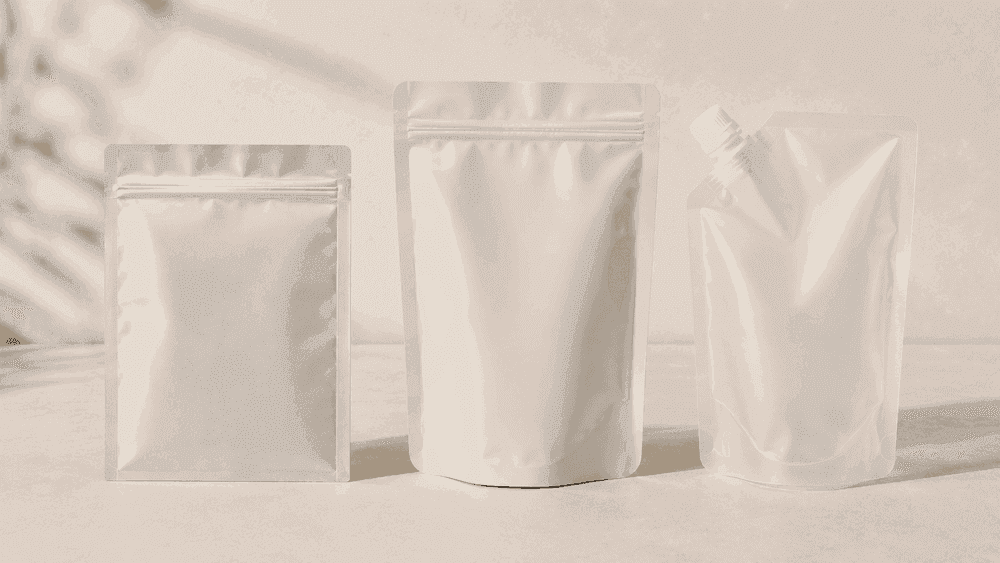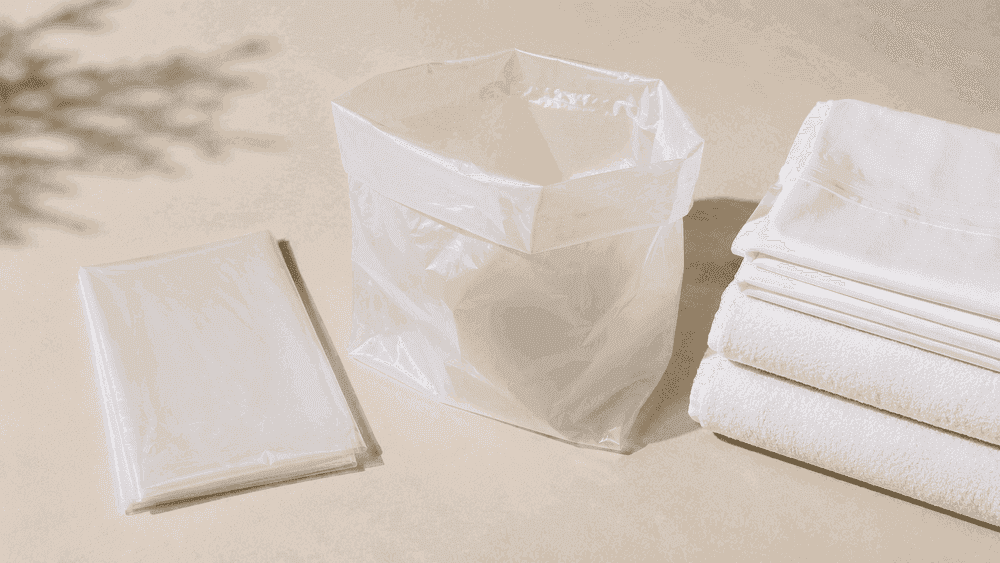
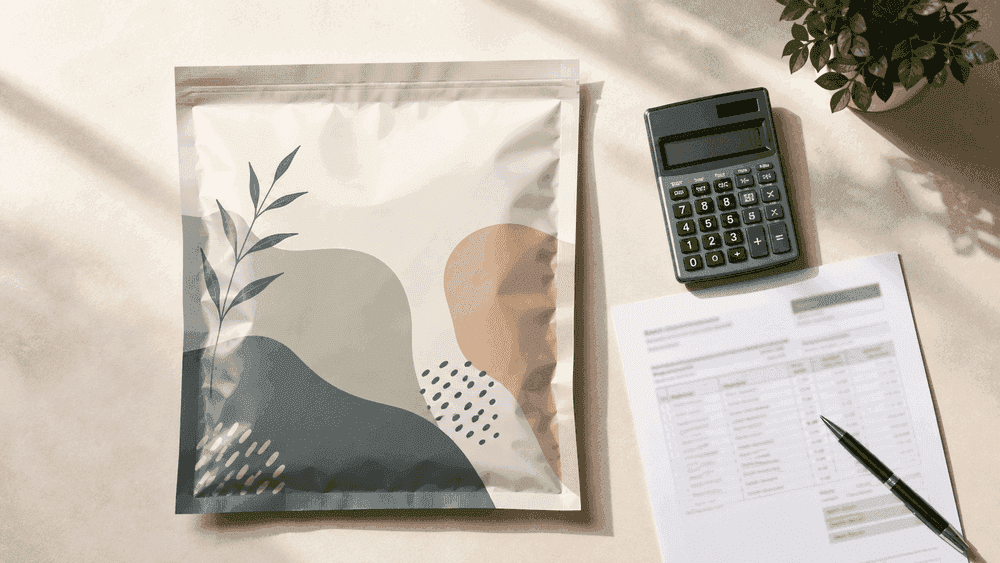
Ask three suppliers for the same bag and you will get three different numbers, sometimes far apart. That usually does not mean two of them are overcharging. It means you have been quoted three different bags. This is a plain guide to printed bags price in Pakistan — what actually moves the number, written the way we work it out on the factory floor rather than the way a rate card pretends it works.
The first thing to understand: bags are priced by weight
This is the single biggest lever, and it is the one buyers underestimate most.
Film is bought by the kilo. The bag is made from film. So the real question behind your rate is not "how many bags" — it is "how many kilos of film do these bags come to." Two things decide that:
- Size. A bigger bag uses more film. The relationship is not gentle either: adding an inch to both the width and the length adds more material than most people expect, because you are adding area, not a line.
- Thickness. Film thickness is quoted in microns, and you will see that word on any serious quotation. A thicker film costs more per bag for exactly the same dimensions.
This is why "what's your rate for zipper bags" cannot be answered honestly. Without a size and a thickness, there is no bag to price.
It is also why the cheapest quote in your hand may simply be a thinner bag. Before comparing two numbers, check that both are for the same size and the same micron. If a quotation does not state the micron, that is worth asking about before anything else.
Printing is the second lever
There are three real choices, and they sit at genuinely different price levels.
- Plain, no printing. Carries no printing cost at all. If your bag is going inside a carton and nobody sees it, this is money you do not need to spend.
- Flexographic printing. Our in-house workhorse for straightforward colour work — logos, brand names, simple designs. The economical printed option.
- Gravure printing. For detailed, multi-colour artwork, photographic images and fine gradients. The print quality is a clear step up, and so is the cost, both in the rate and in the quantity you need to order.
There is one more printing decision that surprises people: printing both faces of the bag costs more than printing one. Not just the printing itself — on some bags it also raises the quantity you need to order. If the back of your bag only carries a small note or a barcode, it is worth asking whether it earns its place.
The extras that quietly move the number
These are small items individually. Together they often explain a gap between two quotes.
- Which zip. A slider zip — the smooth pull-tab kind — costs more than a press-to-close zip, because the slider is a separate physical component fitted to every single bag, on top of the zip track itself. A press-to-close zip has no slider. For premium garment packing, the slider usually earns its cost; for volume packing, it often does not.
- A bottom gusset. The fold at the base that lets a bag stand and hold a thicker product. It adds film, and on the bags where it is offered it also raises the minimum order sharply.
- A handle. D-cut or hanger, both change the construction of the bag.
- Lamination. Bonding two or more films together, which is what gives a bag stiffness, a premium finish and a moisture barrier. Every additional layer is more material and another pass through the machine, so a laminated bag is a genuinely different price class — not a slightly dearer version of a plain one.
- Transport. Always quoted separately and confirmed in your quotation, never buried in the rate.
Why a small run costs more per piece
The work of setting up a job barely changes with quantity. The artwork still has to be prepared, the machine still has to be set, the first material still runs off as waste before the print settles. That effort is the same whether you order a little or a lot — it is just spread across fewer bags.
So a run at our minimum is priced higher per piece than a large run of the identical bag. This is not a penalty for being a small buyer. It is the setup showing up more visibly when there are fewer pieces to carry it.
There is also a one-off charge worth knowing about before you commit. Printing needs a physical carrier for your artwork — plates for flexographic printing, engraved cylinders for gravure. These are made once for your design, reused on every repeat order of the same artwork, and charged separately from the per-piece rate. On larger orders that charge can be adjusted or absorbed; terms apply, and it is settled in writing in your quotation rather than assumed either way.
The practical takeaway: if you are close to a larger quantity, ask what the rate looks like there before deciding. The per-piece difference between "just enough" and "a proper run" is often larger than buyers expect.
The minimum order — and the part most buyers get wrong
Almost everyone assumes the minimum comes from the bag. It does not. It comes from the process you have chosen.
Gravure printing needs a much larger run than flexographic printing to be worth setting up. Lamination carries its own minimum, set by the laminating machine rather than by your bag. So changing your printing method changes your minimum, even if the bag itself is identical.
Two things follow that are worth knowing:
- Combining processes does not add the minimums together. If your bag is both printed and laminated, you do not owe the printing minimum plus the lamination minimum. The larger of the two applies.
- Adding a zip can lower the minimum, not raise it. It sounds backwards and it is genuinely true on some bags.
You are told the minimum for your specification honestly, before you commit. What we will not do is quote a rate you cannot actually have at the quantity you are asking about — a number you cannot order is not a quotation, it is a decoy.
Why the cheapest quote is often the most expensive
A lower number is not automatically a better deal, and it is usually not a favour either. It is nearly always a different specification. The common places a price gets cut:
- Thinner film than you asked for, which shows up as split seams in transit rather than at the time of quoting.
- Fewer colours, or flexo where the artwork genuinely needed gravure — fine detail comes out muddy.
- A cheaper closure, so the slider zip you specified quietly becomes a press-to-close one.
None of this is visible on a quotation that lists only a rate. It becomes visible when the goods arrive. The defence is simple: insist that every quote you compare states the size, the micron, the printing method and the closure. Once those four match, the numbers are finally comparable — and at that point a genuine price difference is a real difference.
What to send for a real number
We can price a bag properly from five things:
- The size you need, or the product going inside it if you would rather we worked the size out.
- Roughly how thick the film should be, if you know — and if you do not, tell us what the bag has to survive.
- Your artwork, or the number of colours in it.
- Whether you need a zip, a handle or a gusset.
- The quantity you expect to order.
With those, you get a real rate for your bag and an honest minimum, not a rate-card figure that changes once anyone actually looks at your job. We sell factory-direct with no middleman in between, and our agents visit buyers in person across eleven cities — including Faisalabad and Jhang — so the specification can be settled properly rather than guessed over a phone call.
Want a real price for your bag?
Send your size, artwork and expected quantity, and we will come back with a rate for your actual specification.
Where to go next
If you already know what you are packing, the fastest route to a real number is that product's own page — pouches for food, spices and dry goods, laundry bags for hotel and commercial laundry work, or our full range for everything else.
If you have not settled the specification yet, two companion guides go deeper on the choices that move the price most: large pouch or small pouch and choosing laundry bags for hotels and laundries.