
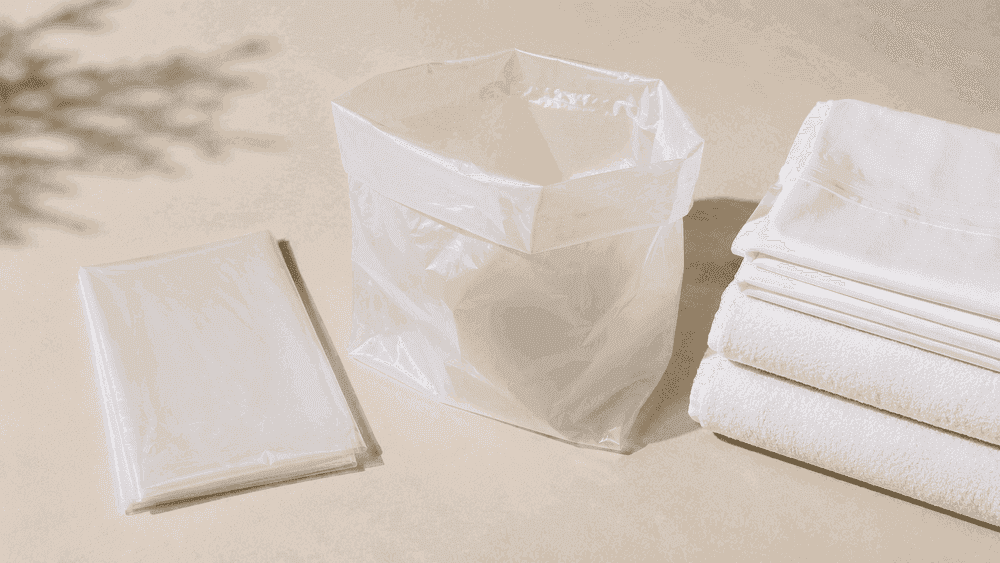
Most buyers go looking for laundry bags the way they would go looking for a size of shoe — expecting a catalogue with standard options to pick from. There isn't one. Laundry bags for hotels and commercial laundries are made to order, every dimension of them, and the reason is straightforward: the bag that works in a five-star wardrobe and the bag that survives a working laundry floor have almost nothing in common except the name.
That sounds like more work than picking from a list. It is actually less, once you know the four things you are deciding.
First: which of the two jobs is this bag doing?
The same two words cover two genuinely different products, and getting this wrong is what causes almost every laundry bag complaint we hear about.
- A hotel guest bag is seen. It sits in a wardrobe or bathroom, usually carries the hotel's name, and holds one guest's clothes for a short trip downstairs. It is light, it looks like part of the room, and it is used once.
- A commercial laundry bag is worked. It is filled heavy, dragged, stacked, loaded onto trolleys, and often used again tomorrow. Nobody looks at it. It only has to not fail.
We make both. But a bag specified for the first job will split the first week it does the second, and a bag built for the second is money wasted sitting in a guest room. Decide this before anything else, because the other three decisions all follow from it.
Size: you set it, so set it from the load
Because these are cut to your size, there is no list to choose from — which means the temptation is to repeat whatever size you ordered last time.
Look at the load instead:
- For a hotel bag, one guest's clothes for a short stay. It only ever holds that.
- For a commercial bag, whatever weight your staff can still lift comfortably when it is full. That is the real ceiling, and it has nothing to do with what the film can take. If a full bag needs two people, the bag is too big no matter how strong it is.
Bring us the load — what goes in, how it is carried — rather than a set of dimensions copied from an old invoice that may never have been right.
Gauge: there is no catalogue number, because it depends on the material
Gauge is the thickness of the film, and it is what decides whether the bag survives its job. It is also the question buyers most want a simple answer to, and the one that genuinely does not have one.
Gauge here depends on the material combination the bag is built from. Different films behave differently at the same thickness, so a number that means "tough" in one construction means very little in another. Quoting you a gauge figure without knowing the material would be a number with nothing behind it.
What that means in practice: specify the job, not the micron. Tell us the weight it carries, whether it gets reused, and how roughly it is handled, and the material and gauge get chosen together to hit that. Then take a sample and fill it the way your staff actually fill it. A day of that prevents a year of complaints, and it is worth more than any figure printed on a website.
Closure and handle are open, not fixed
This is where made-to-order genuinely pays off, and where most buyers assume they have fewer options than they do.
There is no menu here either. Whatever closure and handle your operation needs is built into the bag — it is specified with your order rather than chosen from a fixed set, the same way the size and gauge are.
So describe how the bag is used and let the answer follow from that. A guest bag a housekeeper collects needs to close easily with one hand. A commercial bag that gets dragged needs a handle that will not tear out of the film at the point it is carried from. Those are different bags, and both of them are buildable.
What "heavy duty" actually means here
Buyers search for heavy-duty laundry bags constantly, so it is worth being clear: there is no separate heavy-duty product line sitting alongside a standard one.
What heavy duty means in practice is a heavier gauge and a material combination chosen for toughness. It is the same bag, specified upward. So you do not need to ask whether we make a heavy-duty version — you need to tell us how hard the bag's life is, and it gets built to that.
What to send for a rate
Four things get you a real number:
- Which job — hotel guest bag, commercial laundry, or something else.
- What goes in it, and roughly what that weighs when full.
- How it is handled — carried, dragged, stacked, reused or used once.
- Plain or printed, with your artwork if printed, and the quantity you expect.
Notice that none of those asks you for a specification. That is deliberate — describing the job is your side of it, and turning that into a size, a material, a gauge, a closure and a handle is ours.
We make these as tough poly bags in our own Faisalabad plant, cut to your size, plain or printed, supplied nationwide factory-direct with no middleman in between.
A note on printing
Most laundry bags go out plain, and for a working laundry that is usually right — spend the money on gauge instead.
For a hotel it is often the opposite. The bag sits in a guest's room carrying your name, which makes it one of the very few pieces of packaging a guest actually handles. Flexographic printing covers business names and logos comfortably and costs little on a volume item.
The test is simple: does a customer see this bag?
Need laundry bags built for your operation?
Tell us what the bag is for and what it has to carry — we will come back with a size, a material and a rate.
Where to go next
Full details and a direct quote route are on the laundry bags page. If you are buying other packaging too, what actually decides the price of printed bags explains what moves any bag quote up or down.