Most buyers start the same way: "I need a large pouch," or "I need small pouches." It is a completely reasonable way to describe what you want, and it is also the reason so many first quotes come back wrong. Large and small are not types of packaging pouches — they are descriptions of capacity. The actual choice sits somewhere else, and getting it right the first time saves a round of samples.
What you are really choosing between
Set size aside for a moment. Every pouch decision comes down to one question: how does the pack need to behave once it is filled?
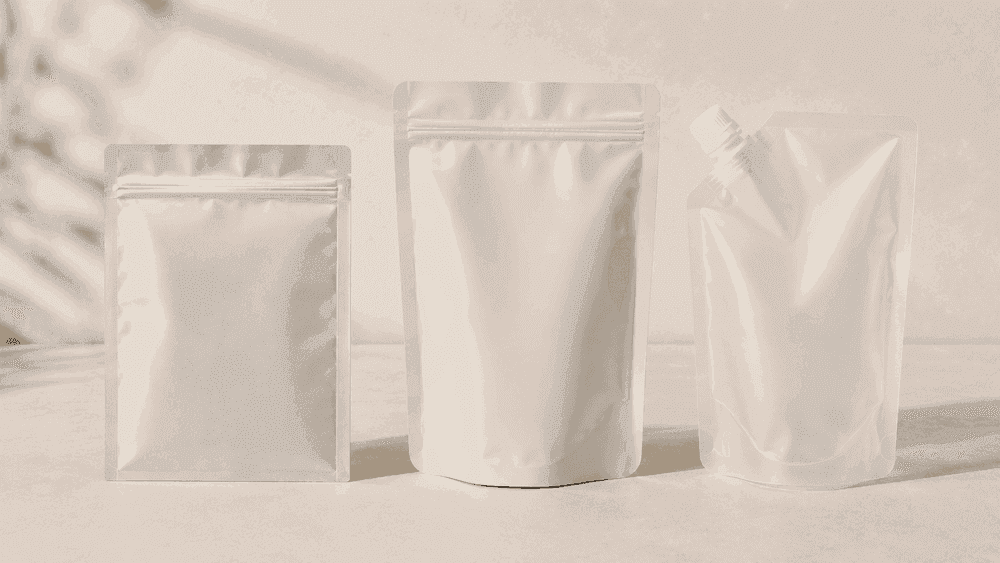
There are three answers, and they are three different products:
- A flat pouch lies flat. Cheapest to make for the same capacity, best for products that sit in a carton or hang on a peg.
- A stand-up pouch stands upright on a shelf, because it has a gusset folded into its base that opens out when filled.
- A spout pouch stands up and pours, because a plastic nozzle is fitted to it.
Once you know which of those three you need, size becomes an easy conversation. Start with size and you can end up with a pouch that technically holds your product but falls over on the shelf.
Flat pouches — the workhorse
This is what we make most of, in two seal types.
- Centre seal — the seam runs down the back of the pouch.
- 3 side seal — sealed on three edges, the fourth being the fill opening.
They suit spices, tea, namkeen, dry fruit and bakery products: things that are sold by weight, stacked or boxed rather than displayed standing, and that need a proper barrier more than they need a shape.
The seal type is not just cosmetic. Centre seal and 3 side seal price differently, because sealing changes the film width the pouch is cut from — not simply the rate. That is worth knowing when you compare two quotes that both say "pouch."
Stand-up pouches — when the shelf is the salesman
A stand-up pouch, or doypack, has a bottom gusset that opens into a base when the pouch is filled. It stands up on a retail shelf and stays standing as it empties.
This is the format for salt, rice, detergent, ketchup, mayonnaise and atta. Anything a customer picks off a shelf and compares against a competitor's pack sitting beside it.
Stand-up pouches are a retail format, and the fill weights reflect that. The everyday range runs from around 50g up to about a kilo — 50–100g, 250g, 500g and 1kg are all common. Within that span the gusset depth, the film and the minimum order all move with the fill weight, which is exactly where "large pouch" and "small pouch" come from, and why those words alone are not enough to quote from.
Spout pouches — for anything that pours
A spout pouch is a stand-up pouch with a nozzle fitted: juices, sauces, liquid products generally.
We run spouted pouches at 100g, 200g, 300g, 500g and 1kg fills — the same retail span as stand-up pouches, which follows, since a spout pouch is a stand-up pouch with a fitting added.
One thing to know before you specify one: the spout is a separate physical component fitted to every pouch, on top of the pouch itself. It is not a shape moulded into the film. That makes it a genuinely different cost class from a plain stand-up pouch, and it is the first question to ask when a spouted quote looks higher than you expected.
Which format your fill weight points to
Capacity narrows the choice faster than anything else.
| Fill weight | Usual format |
|---|---|
| 50–100g | Flat or stand-up — both common |
| 250g | Flat or stand-up — both common |
| 500g | Flat or stand-up — both common |
| 1kg | Flat or stand-up — both common |
| 5kg | Flat pouch |
| 10kg | Flat pouch |
To make that concrete, three sizes we actually run:
| Fill weight | Format | Size |
|---|---|---|
| 250g | Stand-up | 4 × 6 in, 2 in gusset |
| 1kg | Stand-up | 8 × 10 in, 2 in gusset |
| 5kg | Flat | 13 × 20 in |
You will often see the first two written as 4×6+2 and 8×10+2 on a quotation — the figure after the plus is the bottom gusset. Worth recognising, because a quote listing only two numbers for a stand-up pouch has left something out.
These are real running sizes rather than a fixed menu. Density moves them: a kilo of powder and a kilo of snacks need different pouches, which is why we ask what is going inside rather than only how much.
Up to about a kilo, the choice is genuinely yours: it comes down to whether the pack has to stand on a shelf. Above that, weight decides for you — a 5kg or 10kg pack is made as a flat pouch, because a gusseted base stops earning its cost once the pack is heavy enough to sit rather than stand.
Spout pouches sit inside that same retail span — 100g, 200g, 300g, 500g and 1kg — rather than following the flat-pouch route upward.
We do not run 25kg sacks. If that is what you need, it is a different product from a different kind of supplier.
The barrier question — why food pouches are laminated
Every pouch we make is laminated — two or more films bonded together rather than one film on its own. We do not make an unlaminated pouch, and that is a deliberate decision rather than a gap in the range.
The reason is that a single film does not give you a real moisture, oxygen and grease barrier, and those three are what decide whether your masala keeps its aroma, your namkeen stays crisp and your bakery product does not go soft on the shelf. Lamination is the difference between packaging that contains your product and packaging that protects it.
It costs more, and it should — every layer is more material and another pass through the machine. So if a quote you are comparing comes in noticeably below ours on a pouch, it is worth asking how many layers it is built from. A cheaper unlaminated pouch is not the same product at a better price; it is a different product that tends to show up later as returns.
Printing: gravure or flexo
For food and FMCG pouches, gravure is the standard choice. It gives the sharp, photo-quality print that buyers expect on a retail pack, and food packaging is a category where print quality is read as product quality.
Flexographic printing is available and is the sensible choice for simpler artwork and lower-volume runs. It is genuinely more economical — it just handles fine detail and photographic images less well.
If your pouch goes on a shelf next to a competitor, print method is not a place to economise. If it goes into a carton and gets opened in a kitchen, it may well be.
How to describe your size without guessing
You do not need to arrive with dimensions. What we actually need is simpler:
- The fill weight — 250g, 1kg, 5kg.
- What is going inside, because density changes everything. Five kilos of rice and five kilos of puffed snacks are wildly different pouches.
- Whether it stands on a shelf or sits in a carton.
- Your artwork, or the number of colours in it.
From that we work back to a real pouch and a real quantity. Give us dimensions copied off a competitor's pack and we will build to those instead — which is fine, but only if that pack was right for your product in the first place.
Not sure which pouch fits your product?
Tell us what you are packing and roughly how much goes in each pouch — we will come back with the right format and a rate.
Where to go next
Once you know the format, go straight to its page: laminated pouches for flat centre-seal and 3-side-seal packs, stand-up pouches for shelf-ready doypacks, or spout pouches for liquids.
And if the number is what you are really after, what actually decides the price of printed bags explains what moves a pouch quote up or down.